The other two layers
October 16, 2026
Software and Software as a Service have been such a part of all of our lives for so long that it is hard to imagine a world without them. But that is the world we are heading into with the advent of large language models (LLMs). Any of us who have used LLMs know that they are frustratingly brilliant - capable of piecing together complexity in ways few of us could have imagined a few years ago, but utterly incapable of reliably managing, well, anything. No computational architecture works in isolation, not even in biology and certainly not in silico. The technical world and its funders seem to largely understand that LLMs are a catalyst for a new computational framework with two additional layers that are just as necessary as the first. The second layer we will refer to as the Orchestration layer and the third is the Validation layer.
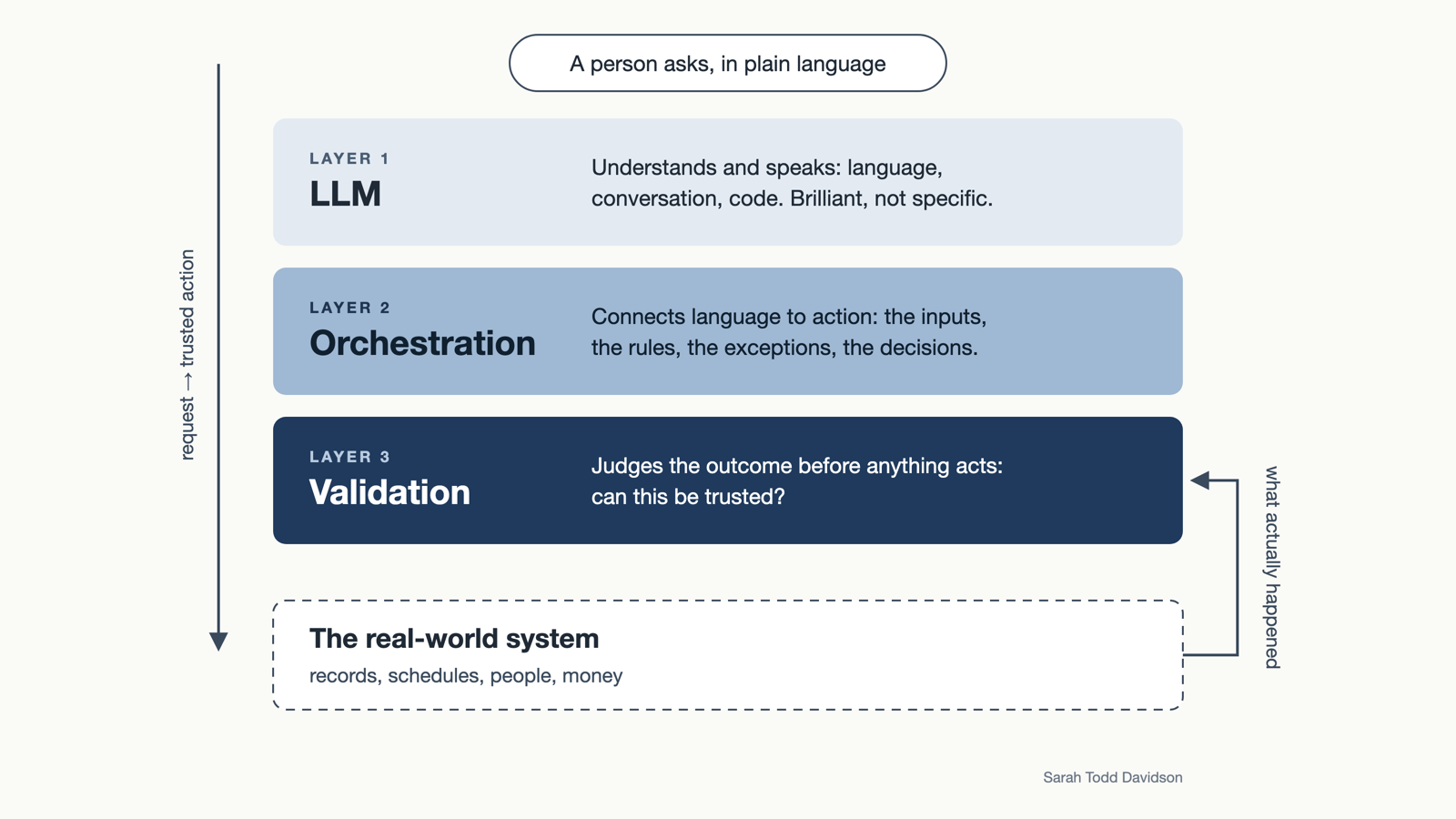
The three layers, simplified.
Great. We know what the LLM layer is; most of us interact with it through an AI assistant. But what are the other two layers? Orchestration is the bridge between a brilliantly non-specific LLM and the ability to take action. Orchestration provides the solid footing for real world application - the inputs, the rules, the exceptions, the decisions. The honest reckoning of how a system actually behaves, not just theoretically. And the third layer? Validation. This one is the most challenging, but consider it the judgement framework that ensures the interaction through the LLM, its application to a real world system, can be a trusted outcome.
Take a patient who asks their AI for an appointment. The LLM understands the request. Orchestration knows the practice: its schedule, its rules, the patient's record. Validation decides whether this time is the right one, and checks after the visit whether it was.
"The wall isn't missing data. It's missing decision traces."
Ashu Garg, Foundation Capital, AI's trillion-dollar opportunity: Context graphs
It dawned on me today that words matter immensely when talking about these capabilities in the tech or tech adjacent sphere. When I say I built an engine that does X - people automatically assume I mean a software engine, and anyone tuned in to the revolution realizes that is a dying category. What I have to learn to convey more accurately is that the engines I have been developing are layers 2 and 3 of this new architecture - I just didn't realize it, because I was eyeball deep in creation, while conference attendees were learning the new language. Turns out as a founder, especially now, the words matter. So let me be clear - I am not building software in the old sense. I am building the orchestration and validation layers of the new AI managed world.
Sarah Todd Davidson is the founder and CEO of PAUL Health and the founder of Eyrie.